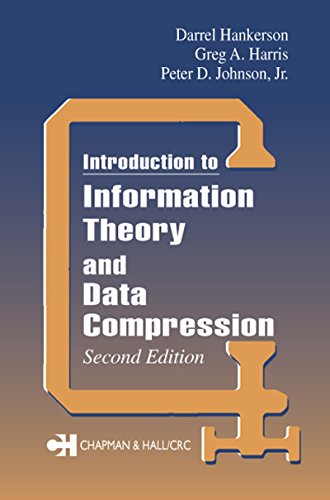

Are you looking for place to read full E-Books without downloading? Here you can read Introduction to Information Theory and Data Compression, Second Edition (Applied Mathematics). You can also read and download new and old full E-Books. Enjoy and relax Reading full Introduction to Information Theory and Data Compression, Second Edition (Applied Mathematics) Books online. .
An effective blend of carefully explained theory and practical applications, this text imparts the fundamentals of both information theory and data compression. Although the two topics are related, this unique text allows either topic to be presented independently, and it was specifically designed so that the data compression section requires no prior knowledge of information theory.
The treatment of information theory, while theoretical and abstract, is quite elementary, making this text less daunting than many others. After presenting the fundamental definitions and results of the theory, the authors then apply the theory to memoryless, discrete channels with zeroth-order, one-state sources.
The chapters on data compression acquaint students with a myriad of lossless compression methods and then introduce two lossy compression methods. Students emerge from this study competent in a wide range of techniques. The authors' presentation is highly practical but includes some important proofs, either in the text or in the exercises, so instructors can, if they choose, place more emphasis on the mathematics.
Introduction to Information Theory and Data Compression, Second Edition is ideally suited for an upper-level or graduate course for students in mathematics, engineering, and computer science.
Features:
The treatment of information theory, while theoretical and abstract, is quite elementary, making this text less daunting than many others. After presenting the fundamental definitions and results of the theory, the authors then apply the theory to memoryless, discrete channels with zeroth-order, one-state sources.
The chapters on data compression acquaint students with a myriad of lossless compression methods and then introduce two lossy compression methods. Students emerge from this study competent in a wide range of techniques. The authors' presentation is highly practical but includes some important proofs, either in the text or in the exercises, so instructors can, if they choose, place more emphasis on the mathematics.
Introduction to Information Theory and Data Compression, Second Edition is ideally suited for an upper-level or graduate course for students in mathematics, engineering, and computer science.
Features:
What Book Should I Read,Books To Read Before You Die,How To Read A Book,Reading Books,Reading Books Online,Good Books To Read For Teens,Books Everyone Should Read,Classic Books To Read,Free Books To Read Online,Read A Book,Top 100 Books To Read
New Books To Read,Free Books Online To Read,Read Books Online For Free,Calgary Reads Book Sale,Book To Read,Read Romance Books Online,100 Books To Read Before You Die,Books You Must Read,Free Online Books To Read,Read Online Books,Read Books,100 Books You Must Read,Books To Read For Kids
Download Here
Mirror : Link 1 - 48,411 KB/Sec
Mirror : Link 2 - 40,005 KB/Sec
First You Must Sign Up and then please follow instruction step by step until finish to get Introduction to Information Theory and Data Compression, Second Edition (Applied Mathematics) for free. Enjoy It